Older coins do not become valuable automatically.
Market 1951 Half Dollar value remains determined by technical parameters and current trading conditions.
Produced by three United States minting facilities, this series reflects the post-war economic recovery period.
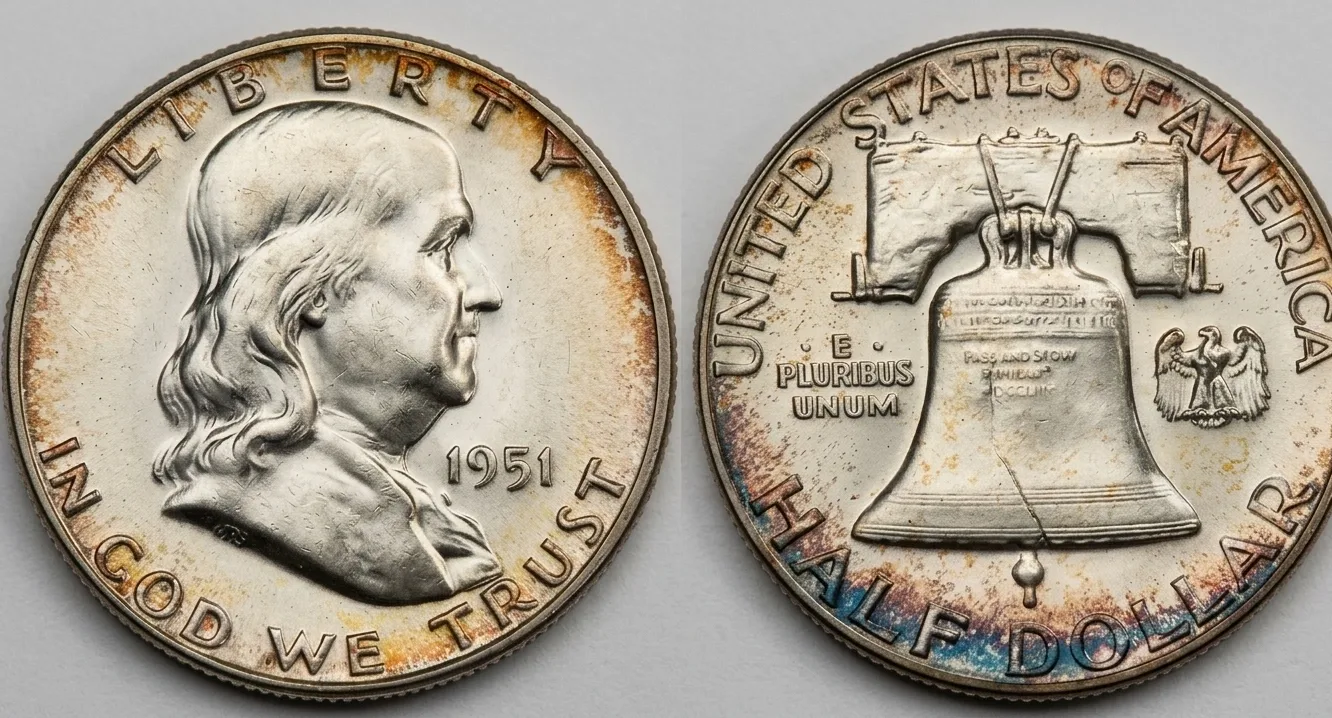
The front side features Benjamin Franklin, replacing the previous Walking Liberty design.
The back side displays the Liberty Bell, showing a small crack and a tiny eagle positioned to the right.
Total production reached 39,973,302 units, distributed among Philadelphia, Denver, and San Francisco plants.
| Parameter | Value |
| Total Mass | 12.5 grams |
| Silver Metal Content | 11.25 grams |
| Body Diameter | 30.6 millimeters |
| Edge Thickness | 1.8 millimeters |
| Metal Alloy | 90% Silver, 10% Copper |
| Edge Type | Reeded |
Weight deviations exceeding 0.2 grams indicate significant wear or illegal duplication.
The silver metal component establishes a minimum market floor price regardless of collector demand shifts.
Distribution of Production by Facility
Manufacturing plants operated with varying workloads during the 1951 calendar year.
- Philadelphia (no mark) — 16,802,102 units
- Denver (letter D) — 9,475,200 units
- San Francisco (letter S) — 13,696,000 units
Identification letters sit directly above the Liberty Bell on the back side.
Lack of a mark identifies the coin as originating from the Pennsylvania facility.
Market Value Determinants in 2026
Current pricing stems from raw metal costs combined with numismatic premiums.
With silver metal priced at $35 per 31.1 grams, the intrinsic value equals $12.65.
→ Metal price increases of 5% raise the base value by $0.63.
→ Price drops of 10% reduce the liquidity of common specimens by $1.26.
| Condition Grade | Philadelphia (No Mint Mark) | Denver (D) | San Francisco (S) |
| Very Fine (VF) | $15 | $15 | $15 |
| Extremely Fine (EF) | $18 | $18 | $18 |
| About Uncirculated (AU) | $22 | $25 | $23 |
| Mint State 63 (MS63) | $45 | $55 | $50 |
| Mint State 65 (MS65) | $165 | $185 | $210 |
Prices exceeding the average by 20% usually apply to coins retaining original factory luster.
Coins displaying deep scratches or signs of cleaning lose up to 40% of their premium value.
Preservation Analysis and Full Bell Lines Classification
Specific grading for the Franklin series involves the detailing found on the Liberty Bell.
Visible horizontal lines at the bottom of the bell raise the category to FBL status.
Specimens possessing these clear lines trade at multiples of standard issue prices.
- Absence of breaks on the lines → FBL status confirmed.
- Presence of scratches crossing the lines → FBL status rejected.
| Sheldon Scale Grade | Standard Price | Full Bell Lines (FBL) Price |
| MS64 | $75 | $140 |
| MS65 | $175 | $450 |
| MS66 | $420 | $1,950 |
| MS67 | $2,100 | $16,500 |
Value growth for the MS66 FBL category averages 8% annually in stable markets.
Demand for lower grades drops by 3% each year due to excess supply.
Historical Auction Records
Trading history records extreme values for exceptional specimens.
A 1951-S coin graded MS67 FBL sold via Heritage Auctions for $21,150.
A 1951-D specimen of identical quality reached a price of $15,275.
The Philadelphia 1951 issue without a mark in MS67+ FBL condition attained $12,925.
Five-year sales statistics reveal the following patterns:
- Grades above MS66 grow in value by 12% annually.
- MS63-MS64 grades remain stagnant with 1.5% price fluctuations.
- Discovery of new certified MS67 specimens lowers prices by 5% through reduced scarcity.
Quality Assessment for 1951 Proof Coins
Improved quality coins were manufactured exclusively in Philadelphia for official sets.
Total output reached 57,500 units.
Surface quality features a mirror-like background and frosted relief.
Proof coin classification includes three levels of visual contrast.
- Standard Proof → Uniform shine across the entire surface.
- Cameo → Noticeable contrast between the background and the portrait.
- Deep Cameo (DCAM) → Maximum contrast imitating a frost effect.
| Contrast Category | PR67 Grade | PR68 Grade | PR69 Grade |
| Standard Proof | $850 | $3,200 | $14,500 |
| Cameo | $1,900 | $7,500 | Data unavailable |
| Deep Cameo | $6,500 | $28,000 | No specimens found |
Annual appreciation for Cameo coins reaches 15% due to their rarity in this specific year.
Investment appeal for standard proofs remains lower because of high survival rates.
Toning Impact on Pricing
Natural oxidation of the silver metal surface creates a unique color layer.
Rainbow toning covering either side increases the final auction bid.
Bright blue and gold hues receive higher valuations than grey or black coatings.
- Presence of aesthetic toning → 50-150% markup.
- Presence of dark spotted toning → 20% discount.
Toning processes take decades when coins stay stored in cardboard albums.
Artificial coloring, easily detected by experts, cancels all numismatic value.
Comparison of Manufacturing Defects
Minting errors for 1951 appear rarely, attracting specialized interest.
Significant defects include several types of deviations.
- Doubled image elements (Double Die) → Found on legend lettering.
- Off-center striking → Partial absence of the image on the metal blank.
- Die cracks → Raised lines appearing on the coin surface.
Price for a 10% off-center coin starts at $250.
Shifts exceeding 50% with a visible date increase the value to $1,500.
Slight doubling of letters on the back side adds approximately $50 to the price.
Investment Strategy for the 2026-2030 Period
Investing in United States silver coins requires understanding market cycles.
Scenario A: Silver metal grows to $45 per unit.
→ Liquidation value rises to $16.20.
Scenario B: Interest in physical collecting declines.
→ Prices for low-grade coins drop to the raw metal level.
Asset acquisition recommendations:
- Purchase MS66 FBL for long-term holding exceeding 10 years.
- Avoid uncertified coins priced above $100.
- Focus on specimens with documented ownership history.
Probability of finding a rare variant in bulk scrap equals 0.005%.
Searching for rare defects requires using a coin identification app.
Certification and Professional Evaluation Specifics
Verification of authenticity and condition is performed by independent services.
Plastic holders protect the metal from contact with oxygen.
Professional checking eliminates the risk of buying fakes made from cheap alloys.
- Determining metal alloy authenticity.
- Grading wear levels on a 70-point scale.
- Assigning quality tags like FBL or Cameo.
Evaluation service costs range from $30 to $150 per unit.
Economic viability for grading occurs when market value exceeds $150
1951 Against Adjacent Dates
The 1951 year holds a middle position for rarity within the Franklin series.
It remains more expensive than 1963 mass issues but more affordable than key dates like 1948 or 1949-S.
| Production Year | Mintage (Millions) | MS65 Price (Average) |
| 1949-S | 3.7 | $350 |
| 1950 | 7.7 | $110 |
| 1951 | 16.8 | $165 |
| 1952 | 21.1 | $95 |
Increased production in 1952 led to reduced scarcity.
The relative rarity of 1951 in high grades stems from poor metal blank quality during that era.
Most coins left the press showing numerous small marks.
Geographic Location of Remaining Stock
The majority of coins remain in private collections within North America.
The European market offers limited selection, often marking up prices by 15-20%.
Asian investors began showing interest in American silver metal in 2024.
→ Demand from China increasing by 4% annually.
→ Open auction listings decreasing as assets move to private funds.
Discovery of original 1951 bank rolls is considered exceptional luck.
The price for one 20-coin roll in unopened condition reaches $1,200 for Philadelphia.
Denver rolls can cost up to $1,500 because of higher demand for the D mark.
Inflationary Impact on Numismatics
Currency inflation during 2024-2025 pushed investors toward hard assets.
The 1951 silver 50-cent piece serves as a capital preservation tool.
Returns on MS65 investments over the last 10 years beat inflation by 2.5%.
Volatility remains lower than that seen in digital currencies or tech stocks.
Liquidity risk exists only when attempting urgent sales of rare grades.
Common coins sell instantly at silver metal scrap prices.
Storage Rules to Prevent Degradation
The 90% silver metal reacts poorly to sulfur found in the air.
Surface darkening to a coal-black color reduces visual appeal.
- Use of acid-free paper envelopes.
- Maintaining indoor humidity at 30-40%.
- Eliminating sudden temperature shifts.
Storing coins in plastic holders containing PVC is forbidden due to acid release.
Green buildup on the copper metal within the alloy is irreversible.
Detecting metal degradation requires immediate relocation to a neutral environment.
Conclusion
The 1951 50-cent coin remains a stable object for collection.
Its value is determined by back-side strike quality and overall surface condition, and can be checked with the best free coin identifier app.
The 75-year age of the coin in 2026 acts only as a background factor.
Investment priority should target coins with the FBL designation.
The 2026 market shows resilience against external economic shocks.
A professional approach to evaluation guarantees the preservation and growth of funds.
Further study of minting archives may reveal data regarding minor die varieties.
Constant price monitoring allows for purchases during market corrections.
Collecting United States silver metal remains a prestigious and financially sound activity.